
PDF Ebook The Sentences, Book 4: On the Doctrine of Signs (Mediaeval Sources in Translation)
The Sentences, Book 4: On The Doctrine Of Signs (Mediaeval Sources In Translation). Bargaining with reviewing practice is no requirement. Reviewing The Sentences, Book 4: On The Doctrine Of Signs (Mediaeval Sources In Translation) is not sort of something sold that you can take or otherwise. It is a point that will change your life to life a lot better. It is the thing that will certainly give you many things all over the world and also this cosmos, in the real world as well as below after. As what will certainly be provided by this The Sentences, Book 4: On The Doctrine Of Signs (Mediaeval Sources In Translation), just how can you haggle with things that has numerous advantages for you?
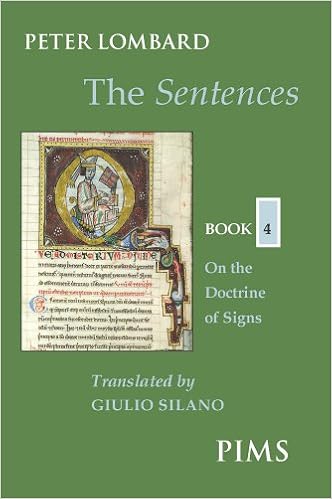
The Sentences, Book 4: On the Doctrine of Signs (Mediaeval Sources in Translation)

PDF Ebook The Sentences, Book 4: On the Doctrine of Signs (Mediaeval Sources in Translation)
Come again, guide that is not just comes to be the tool or way however additionally a true buddy. What type of pal? When you have no good friends in the lonely when you need something accompanying you when during the night before sleeping, when you feel so tired when waiting for the listings, a book could come with you as a true close friend. As well as one of the true pals to extremely suggest in this website will be the The Sentences, Book 4: On The Doctrine Of Signs (Mediaeval Sources In Translation)
The Sentences, Book 4: On The Doctrine Of Signs (Mediaeval Sources In Translation) tends to be referred book, not just by this site. Lots of people have actually verified that it really works to them. Just how's regarding you? As long as the subject and issue that you ace is connected to exactly what this book contains, it will truly aid you. Fixing the troubles can be taken into consideration via numerous resources. Listening to the other guidance is important. Yet, obtaining the truths and ideas from the written sources as well as the specialist will certainly be really completed.
Guide appearance is likewise sufficient. Even there is smart words to not to evaluate guide from its cover. Yet, when the cover has actually been fascinating, it will reasonably attract you to check out the inside or material of guide. Moreover, the choice of words and also arrange to be title is very affecting. It will certainly define exactly what you the writer will utter to the viewers. Those elements are suitable enough with the principle of this The Sentences, Book 4: On The Doctrine Of Signs (Mediaeval Sources In Translation) So, you might not have to be stressed over that.
Getting the skills and experiences of somebody will showcase exactly how you have obtained the benefits as well as qualities of The Sentences, Book 4: On The Doctrine Of Signs (Mediaeval Sources In Translation) You might not feel overwhelmed the best ways to get it. This is the soft documents system of publication that you can obtain as your alternative. In this condition, you should sustain on your own to be someone much better. It can be done by reviewing it gradually however indeed. Conserving the soft data in device and also laptop computer tool will certainly permit you open it anywhere.
Review
To render all of the Sentences into English is a very large task, and a self-effacing one, which the modern academic world does not always appreciate as it ought to. We should thank Professor Silano all the more warmly for this fine accomplishment, which - needless to say - belongs in the library of every seminary, theology department, and medievalist in the English-speaking world. More than that: this translation of the Sentences can be used successfully in many kinds of college-level courses, from general introductions to the medieval world to specialized courses on issues in dogmatic theology. - Philipp Rosemann, American Catholic Philosophical Quarterly
Read more
Product details
Paperback: 336 pages
Publisher: PIMS; 4th ed. edition (September 1, 2010)
Language: English
ISBN-10: 9780888442963
ISBN-13: 978-0888442963
ASIN: 0888442963
Product Dimensions:
6 x 0.9 x 9 inches
Shipping Weight: 1.3 pounds (View shipping rates and policies)
Average Customer Review:
5.0 out of 5 stars
2 customer reviews
Amazon Best Sellers Rank:
#385,616 in Books (See Top 100 in Books)
Great buy..
In On the Doctrine of Signs we come to the bulk of the theological conclusions that were rejected in the Reformation by Protestants and to a great degree maintained by the post-Tridentine Roman Church.Currently, the Roman Church teaches that Jesus’ human body upon the cross “participates in the divine eternity, and so transcends all times while being made present in them all†(CCC-1085). Christ’s atemporal body is obviously an ad hoc, extra-biblical, and mildly bizarre means of explaining a problem that Peter attempted to explain this way:As for the body, he gave [the disciples at the first Lord’s Supper] such a one as he then had, that is, a mortal one, capable of suffering. But now we receive his immortal and impassible body; yet it does not have greater efficacy (4.11. 6.1, pg. 60).Rather than an atemporal body summed into time, Peter’s solution was three sacrifices. Jesus sacrificed his temporal body at the first Lord’s Supper, his temporal body was sacrificed on the cross, and now his “immortal and impassable†is the current sacrifice of the mass.Both the contemporary Roman solution and Peter’s are in formal contradiction to the Bible, reason, and the Chalcedonian Creed which declares that Jesus has “a reasonable soul and body†that is “consubstantial with us.â€Peter goes on to unintentionally illustrate the outcome of merit theology combined with continuing sanctification after death with a thought experiment: two men of equal but imperfect religious merit die and go to purgatory in 4.45.4.1-2, pg. 247. The only difference between the two is that one is wealthy and the other poor: For “the rich one, special and common prayers are offered†and for the poor one only common prayers. There’s a bit of theological poking about and then this conclusion, “those several aids conferred on the rich man a quicker absolution.†Simply put—rich people get out of purgatory more quickly than poor people. Such conclusions are antithetical and irreconcilable with the Bible and the religion of Moses, Jesus, Paul, and James.The historical process by which the roar of the Holy Spirit and James “Come now, you rich, weep and howl for the miseries that are coming upon you,†(James 5:1) is muted to such drivel can be traced in the citations. Augustine writes in about 410 AD: “It is not inconceivable that, after this life, some of the faithful shall be saved through a kind of purgatorial fire, and some more quickly, others more slowly. . .†Augustine’s suggestion is Peter’s dogma, and this was linked to the system of penance and merit with a pagan element of a continuing interrelationship between the living and the dead.The system of penance was so intrinsic to Peter and his contemporaries that he writes, “But the sacrament of penance, like that of marriage, existed before the time of grace, indeed from the beginning of humankind. For each of these was instituted with our first parents†(4.22.2.3, pg. 135). The modern translator provides a biblical citation for “penance in Gen. 2, 17.†“For in the day that you eat of it you shall surely die,†can only be read as a penitential sacrament by reading back the developed tradition of the church into the text.It must also be noted that Peter is not a modern or Tridentine Catholic. He writes, “It is plainly shown here that God does not follow the Church’s judgment, for sometimes the latter judges through deception and ignorance; but God always judges according to the truth (4.18.6.3, pg. 111). The pride and hubris of Trent and Vatican I remain in the future.And though I am horrified by much of what Peter teaches, he does write this, “What is to be held? Surely, that sins are blotted out by contrition and humility of heart, even without confession by the mouth and payment of outward punishments. For from the moment when one proposes, with compunction of mind, that one will confess, God remits; because there is present confession of the heart, although not of the mouth, but which the soul is cleansed inwardly from the spot and contagion of the sin committed, and the debt of eternal death is released†(4.17.1.11, pg. 96). Here we have a rejection of penance and auricular confession as necessary for salvation.Peter’s project was an attempt to synthesize current church practice, past church teachings, the Bible, and reason into a coherent case book of decisions and doctrine for Roman Catholic clergy. But this multitude of witnesses are not merely “various and almost contradictory†(4.27.1.2, pg. 94), they are openly contradictory on a variety of grounds.Peter is aware of the contradictions, because he simply fakes a large number of citations from Augustine, especially on the Lord’s Supper, and purposely does not handle Augustine’s most clear rejection of the physical presence of Christ in the elements in On Christian Doctrine—a work Peter cites in Book I. It should also be noted that the mistaken citations of Augustine appear less dense, in fact rare or or historically more reasonable (Fulgentius rather than Radbertus), in Book I, The Mystery of Trinity, but are much more common in books 3-4. The wider current church practice disagreed with Augustine the bolder Peter was in misattribution.Further, by quoting current defenders of contemporary practice as Augustine, he leaves a trail of bread crumbs for the discerning reading. The trail is left by the Master of the Sentences for a particular kind of reader—“I leave the judgment to the judicious reader†(4.22.1.11, pg. 134) and “I leave the judgment of these to the examination of the diligent reader†(2.27.8.7, pg. 138). No astute and well-read theologian is going to accept Lanfranc quotes in Berengar as Augustine. And so Peter points the discerning reader to what was likely Peter’s true theological convictions or his private beliefs.Benefits/Detriments: The Master of the Sentences provides a helpful introduction to medieval theology. Perhaps more importantly, he exposes the necessity of the Reformation project of grounding theology in a sufficient Scripture rather than in the traditions of man—even godly and brilliant men like Peter, Augustine, and the like.
The Sentences, Book 4: On the Doctrine of Signs (Mediaeval Sources in Translation) PDF
The Sentences, Book 4: On the Doctrine of Signs (Mediaeval Sources in Translation) EPub
The Sentences, Book 4: On the Doctrine of Signs (Mediaeval Sources in Translation) Doc
The Sentences, Book 4: On the Doctrine of Signs (Mediaeval Sources in Translation) iBooks
The Sentences, Book 4: On the Doctrine of Signs (Mediaeval Sources in Translation) rtf
The Sentences, Book 4: On the Doctrine of Signs (Mediaeval Sources in Translation) Mobipocket
The Sentences, Book 4: On the Doctrine of Signs (Mediaeval Sources in Translation) Kindle
Tidak ada komentar:
Write komentar