
Download PDF Upon the Head of the Goat: A Childhood in Hungary 1939-1944, by Aranka Siegal
Upon The Head Of The Goat: A Childhood In Hungary 1939-1944, By Aranka Siegal. Someday, you will certainly discover a brand-new experience as well as understanding by investing even more money. However when? Do you believe that you should get those all requirements when having significantly cash? Why don't you aim to get something basic in the beginning? That's something that will lead you to understand more regarding the globe, journey, some areas, history, home entertainment, and also a lot more? It is your personal time to proceed checking out habit. Among guides you can enjoy now is Upon The Head Of The Goat: A Childhood In Hungary 1939-1944, By Aranka Siegal here.
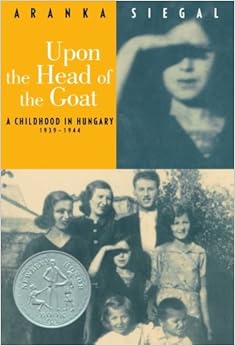
Upon the Head of the Goat: A Childhood in Hungary 1939-1944, by Aranka Siegal

Download PDF Upon the Head of the Goat: A Childhood in Hungary 1939-1944, by Aranka Siegal
Idea in choosing the best book Upon The Head Of The Goat: A Childhood In Hungary 1939-1944, By Aranka Siegal to read this day can be gotten by reading this web page. You can locate the best book Upon The Head Of The Goat: A Childhood In Hungary 1939-1944, By Aranka Siegal that is marketed in this globe. Not just had actually guides released from this country, yet additionally the other nations. And now, we expect you to check out Upon The Head Of The Goat: A Childhood In Hungary 1939-1944, By Aranka Siegal as one of the reading products. This is only one of the best publications to accumulate in this site. Consider the resource and also search guides Upon The Head Of The Goat: A Childhood In Hungary 1939-1944, By Aranka Siegal You could find lots of titles of the books supplied.
When getting the book with the extremely interesting title, really feeling interested is most likely exactly what you will think and really feel. Naturally, lots of people that take Upon The Head Of The Goat: A Childhood In Hungary 1939-1944, By Aranka Siegal as their among the analysis resources also express their curiosity regarding this publication. After getting it as well as reading it web page by page, what did they feel? Are you also so interested with this one? It will certainly be much better for you to see and understand just how precisely this publication comes with.
In this life, in some cases you need something that will certainly captivate you also it likewise provides the good values. Not every one of things must be so stagnant and also complex to obtain good things. Always remember this Upon The Head Of The Goat: A Childhood In Hungary 1939-1944, By Aranka Siegal as one of the sources that you could read. This is exactly what you can take from the book that we promote here. It is also very easy to get and also discover the book.
Based on this condition, to assist you we will show you some ways. You can take care of to review guide minimally prior to going to sleep or in your leisure. When you have the moment in the short time or in the getaway, it could aid you to finish your holidays. This is what the Upon The Head Of The Goat: A Childhood In Hungary 1939-1944, By Aranka Siegal will minimally provide to you.
Review
“A simple and beautiful account of the life of a Jewish family as, step by step, war and anti-Semitism creep closer to the Hungarian town in which they live, finally engulfing them.†―The New Yorker “Through the description of the destruction of this family, the enormity of the annihilation of European Jewry is shown...A sensitive portrait of a remarkable young girl and her family†―Starred School Library Journal“This is a book that should be read by all those who are interested in the Holocaust and what it did to young and old†―Isaac Bashevis Singer
Read more
About the Author
Aranka Siegal's Holocaust novels are based on her own experiences as a child. She lives in Miami, Florida.
Read more
Product details
Paperback: 213 pages
Publisher: Square Fish; 1st edition (March 24, 2003)
Language: English
ISBN-10: 0374480796
ISBN-13: 978-0374480790
Product Dimensions:
5.2 x 0.6 x 7.6 inches
Shipping Weight: 12.6 ounces (View shipping rates and policies)
Average Customer Review:
3.8 out of 5 stars
22 customer reviews
Amazon Best Sellers Rank:
#184,320 in Books (See Top 100 in Books)
I got this book because my daughter needed it for school. She is enjoying it.
I am a 12 year old boy and I had to read this book for my reading honors class and I loved the concept of the book but I felt it was confusing and lots of parts were unexplained. But all in all it was a good book.
It was gud. T t t t t t t t t. T ttt. T t t t. T t
This is a very powerful book.
a fairly good book but not very dramatic and rather slow paced
Enjoyed this book.
This 1940's Hungarian Jewish childhood is a very interesting story for those interested in the old ways of life in small towns of Europe right before and during the war. Told from the viewpoint of a nine year old girl, Piri, from a family of seven, the author writes from her own memory of life with her grandmother on a small piece of land with chickens and a big garden in the countryside. It may not appeal much to those who cannot relate to country and small town life, or who don't like a girlish point of view, or who don't care about the pre-holocaust years where Jewish grownups were under restrictions of which children knew little.I thought the author did a good representation of what a girl would think or see or notice. Many such autobiographies try to give the official background of Nazi or Soviet edicts to clarify for the reader why a sudden change came into the life of an uncomprehending child. She does not do this so one can feel the confusion and anxiety that must creep into the girl's awareness. There are different languages to contend with: Yiddish and Ukrainian and Hungarian and German. There are different outfits: peasant and town clothing.Her own father as a Jew was thrown into the labor arm of the Hungarian army. He sends letters from various work sites but the family never sees him again and his paychecks do not arrive to her mother. Everything is extremely tight and good food becomes scarce. Jobs are engaged in which one is paid in food, such as working for the fishmonger.The actual final roundup into the Local Ghetto, a way station called the Brick factory, is near the end of the novel, when Piri is 13 and already more focused on boys and social status and clothes and jealousy of Teens with More than she has. Her identity is also a kosher Jewish one and she is faced with secular Jewish kids and Zionists who reject the old rules. When all the families wind up there regardless of their beliefs, it is clear that Jews are considered a race above all else. Stripped to their basic belongings and living in crowded filth and always hungry, waiting for over two weeks for trains to bring them to Germany for work camps as they have been told, the teens come to appreciate each other and overcome class and religious differences between themselves.Since we know for the outset where they will wind up, the author is wise in not dwelling on the horrible cattle car ride and the realities of auschwitz. We can learn from her how the life was for a normal Jewish orthodox family before the war. Her mother was an actress before marriage and that seems in itself a little unusual. She remained the cheerful force till the end.I loved Hungary when I visited there in 1985. Pastoral beauty of summer and abundant fruit and tomatoes everywhere! If you want to hear about Hungary this is a great treat.Little tidbits about how a Jew could give himself away while passing as a gentile: if he cracked some eggs and examined the yolks for bloodspots before cooking, then others in the kitchen would know. Apparently the kosher rules forbid eating blood.Her elder sister is very involved in the Zionist movement locally and sneaking out to meetings. Her mother disapproves. Piri accompanies her there once and reports on their enthusiasm. They gather up spare clothes and blankets for arrested Jews. Later these zionist workers find out that Jewish leaders kept the goods locked up for themselves at the brick factory and would not distribute them to the cold and desperate women and children awaiting train transport for weeks on hard floors. Such smallDetails bring the realHistory to life as we see how people come in all sorts, both good and bad.The author wrote a sequel of life after liberation from the camp. I will try to find it.
I pick up a lot of books for my children and myself at the library. I did not realize when I picked this up (it was on hold) that I'd intended it for my 10 year old. I began reading it, and was well engrossed into it before my mother came over and commented on the cover of the book. "You're reading a children's book?" she asked. I had not realized it, but it was a Newbery Honor book, and I looked at the spine and indeed it was a "YA" book. Well, you could have knocked me over with a feather because I honestly could not imagine my 10 year old reading this with much understanding or sympathy. Not because I would not want my children to read this book, don't get me wrong - I would love for them to grasp its connections to the soil, the sunlight and the way families used to live before chemical warfare eradicated a way of life. My children seem so...naive...and I don't know that it's a bad thing for them to be, but I think they would have difficulty with grasping this story because of their lack of awareness of 'evil' in the world, and it might be very hard to relate to for them, and finally, it might give them nightmares. I would feel comfortable if they were in 7th or 8th grade, but at fourth grade, it seems difficult to bring up the few graphic details and high concepts in this story (being 'violated'-raped, suicide - why a doctor kills himself, removal from the neighborhoods, hiding from soldiers, persecution, Jewish diaspora, groping by soldiers, etc., etc.)The book was beautifully written, even with some of the difficulties in following characters (Molcha, for example, is mentioned without introduction and we are supposed to understand who she is, and it goes on in this way throughout the narrative, but it does not detract from the story in any way). Siegal's easygoing writing style and simple but detailed descriptions of daily life are anything but dull. They draw the reader in, and make the reader feel as if they are seated in the kitchen of the Davidowitz family.I am so appreciative to Aranka Siegal for sharing her experiences with us. It must be hard to do, we know it is hard for many people to relive negative experiences orally, let alone write about them. But they are a record of our human history, and necessary for future generations to learn from these experiences and not repeat them.
Upon the Head of the Goat: A Childhood in Hungary 1939-1944, by Aranka Siegal PDF
Upon the Head of the Goat: A Childhood in Hungary 1939-1944, by Aranka Siegal EPub
Upon the Head of the Goat: A Childhood in Hungary 1939-1944, by Aranka Siegal Doc
Upon the Head of the Goat: A Childhood in Hungary 1939-1944, by Aranka Siegal iBooks
Upon the Head of the Goat: A Childhood in Hungary 1939-1944, by Aranka Siegal rtf
Upon the Head of the Goat: A Childhood in Hungary 1939-1944, by Aranka Siegal Mobipocket
Upon the Head of the Goat: A Childhood in Hungary 1939-1944, by Aranka Siegal Kindle
Tidak ada komentar:
Write komentar