
Get Free Ebook Caliban and the Witch: Women, the Body and Primitive Accumulation, by Silvia Federici
Currently we welcome once more, the depictive book collections from this website. We constantly upgrade the collections with the current book visibility. Yeah, released publications are actually covered incidentally of the advised details. The Caliban And The Witch: Women, The Body And Primitive Accumulation, By Silvia Federici web content that is given really features what you need. In order to evoke the reasons of this publication to read, you need to actually know that the background of this book comes from a great writer and also specialist publisher.
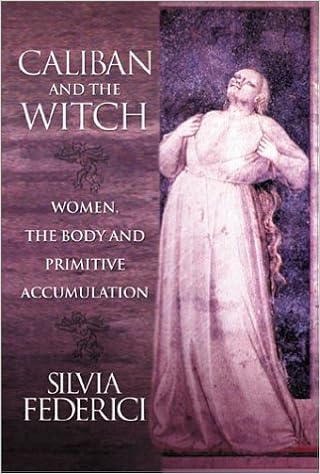
Caliban and the Witch: Women, the Body and Primitive Accumulation, by Silvia Federici

Get Free Ebook Caliban and the Witch: Women, the Body and Primitive Accumulation, by Silvia Federici
Living in this new era will mean you to always compete with others. Among the modal to compete is the idea, mind, as well as knowledge consisted of experience that on by a person. To take care of this condition, everybody must have far better knowledge, minds, as well as thought. It is to feel competed with the others, naturally in doing the compassion and also this life to be much better. Among the manner ins which can be done is by reading.
Caliban And The Witch: Women, The Body And Primitive Accumulation, By Silvia Federici is just what we at to share to you. This book will not obligate you to also read guide precisely. It will certainly be done by supplying the best option of you to assume that reading is always needed. With the smooth language, the lesson of life is presented. Also this is not the particular publication that you possibly like, when reading the book, you can see why many people love to read this.
The book is a publication that can assist you finding the fact in doing this life. Additionally, the advised Caliban And The Witch: Women, The Body And Primitive Accumulation, By Silvia Federici is additionally composed by the expert author. Every word that is given will certainly not worry you to think approximately. The method you enjoy reading could be begun by an additional book. Yet, the way you need to read publication over and over can be begun with this recommended book. As reference this book additionally offers a better principle of how to bring in the people to check out.
And also now, your possibility is to get this book immediately. By seeing this web page, you could in the connect to go straight to the book. And, get it to become one part of this most current publication. Making certain, this book is truly advised for analysis. Whether you are not followers of the writer or the subject with this publication, there is no fault to read it. Caliban And The Witch: Women, The Body And Primitive Accumulation, By Silvia Federici will certainly be actually ideal to review now.
Product details
Paperback: 288 pages
Publisher: Autonomedia; 1st edition (September 15, 2004)
Language: English
ISBN-10: 1570270597
ISBN-13: 978-1570270598
Product Dimensions:
6 x 0.8 x 8.8 inches
Shipping Weight: 13.6 ounces (View shipping rates and policies)
Average Customer Review:
4.6 out of 5 stars
29 customer reviews
Amazon Best Sellers Rank:
#17,806 in Books (See Top 100 in Books)
Federici’s work on feminism goes back to the 1970’s when she felt neither the Radical Feminists nor the Social Feminists provided a satisfactory explanation of the roots of the exploitation of women. In this book she explores the transition from feudalism to capitalism and its affect on women. The title draws on Shakespeare’s The Tempest with Caliban representing the anti-colonial rebel and the Witch representing female heretics, healers, disobedient wives, women who dared to live alone, and those who inspired slaves to revolt. Compare that model of strong women to the new model of femininity which emerged at the end of the 17th Century (after centuries of state terrorism): ideal wife, passive, obedient, thrifty, chaste. Federici investigates the 300 years of witch hunts of the Middle Ages, the role of which she sees to create out of the female body workers for the burgeoning capitalist economy. She tells the horrific story of the many ways that the power of women was destroyed culminating in the massacre and cruel torture of hundreds of thousands of women. The witch hunt was a turning point in women’s lives. No doubt the psyche of every woman is affected still by so many of the strongest of us being so treated. Yet the witch hunt is one of the most understudied phenomena in European history.
My step mom said this book was radicalizing me so she threw it in the trash when I wasn't looking.
The language is highly academic and a struggle for this layman. I barely made it 20 pages in and wass exhausted. I was really excited about this book from all I had heard, too. Maybe when I have more mental energy I will be able to tackle it again. IF you are a voracious reader who isn't fatigued by over complicated language, perhaps you would like to give it ago. The reviews I've read are outstanding.
This book is thought-provoking. Whether you are a victim of sexual assault or not the book places social responsibility on everyone to create an environment that is healthy. I loved this book and how it didn't shy away from discussing deep topics, and how Federici utilized history as a way to back up her claims.
Wow, this book is crammed pack with history and I love that it has the sources listed. Very eye opening on a history we were never taught.
Silvia Federici's book "Caliban and the Witch" demonstrates the absolute necessity of women's studies for a thorough and scientific understanding of history. Focusing on the role of women and the body in the process by Marx and Adam Smith described as "original accumulation", i.e. the violent expropriation of the feudal commons in the movement towards a capitalist society, Federici demonstrates that a true war against women was an important part of the ruling class' strategy.The book assesses various aspects of this development, including witchcraft and the witch-hunts, the "Christianization" (or rather Catholization) of the North and South American native civilizations, the role of philosophical mechanism and the developers of the scientific method (Bacon, Descartes, Newton, Hobbes, etc.), and the early slave trade. In each case Federici masterfully shows how this development came to be, what role it played in the process of 'original accumulation', and why it was favored temporarily by the ruling class. She also gives very strong evidence that things like fear of witchcraft, patriarchy, racism etc., often seen as the inevitable and 'natural' results of ignorance and superstition in those societies, were in reality forced onto the common people as part of a top-down campaign to destroy the backbone of the feudal communities.What is an additional interesting contribution of this book is Federici's evidence that there was not only widespread peasant resistance against the process of enclosure, capitalization and expropriation, but more particularly that women often played a very major role in these resistance movements, especially after the German Peasant War ended in a massacre. Many of the women who would later be burned and persecuted as witches were likely survivors of these resistance movements and therefore both had strong connections with local farming communities and resentment against authority, a dangerous combination for the ruling classes. To me it was also remarkable new information to learn about how common female wage-labor in the cities was in the late Middle Ages and early Renaissance, as well as the degree of acceptance of sexuality and magic. Of course we should not in any way try to paint too rosy a picture of the late feudal era, which everyone knows had enough terror and tyranny of its own, but Federici shows that even then there was a strong current of people resisting both (proto-)capitalism and its predecessor.In her historical panorama, Federici adresses many other writers on women and the body and their subjugation, in particular the feminists, Marx, Foucault and such people as Le Roy Ladurie and Carlo Ginzburg. In my view Federici overstates her case against Marx a bit; she is correct that the role of the subjugation of women in particular was not much addressed by him, but it certainly was by Engels, and I also think that the insights she shows in this work would have been able to count on Marx' full assent. She also seems to miss the fact that "primitive accumulation" is a mistranslation of Marx' term, so that accusations of Marx missing the fact that such expropriatory violence takes place as part of capitalism even today miss the mark.Stronger is her case against Foucault, where she can show that Foucault not only completely ignores the importance of the witch-hunts and the Plague as turning points for feudal and post-feudal society, but that he also locates his famous instrumentalist subjugation of the body far too late in history (Foucault places it at the late 18th century, Federici rather in the 16th). In any case the scope of her knowledge of writers on these subjects is great, and the way in which she gives a context to the ideas of Descartes and other mechanists on "L'Homme Machine" (the term is 18th C.) is striking.Overall, this is an absolute must-read for anyone interested in history, original accumulation and women's studies.
This book showed how the working classes were divided along gender lines as industrial capitalism took over. It also shows the terror campaigns that were conducted to shock the lower classes into accepting the loss of the commons.This book is one of the most educational I've read, but it does suffer from more academic jargon than a non-academic may be used to. A dictionary or google will solve that issue.
This book has a very original point of view about the so called Witch Hunt: reasons were economical more than religious. I surely agree with the writer's view though it must not be forgotten that religion causes to persecution were very strong back then. Of course religion was hiding (like today) the real issue: power. But, as historians, we should be careful not to apply philosophical categories to times they don't belong to. Silvia Federici is anyhow very balanced in her research.This book should be read by all those who are interested in Witches + real history.
Caliban and the Witch: Women, the Body and Primitive Accumulation, by Silvia Federici PDF
Caliban and the Witch: Women, the Body and Primitive Accumulation, by Silvia Federici EPub
Caliban and the Witch: Women, the Body and Primitive Accumulation, by Silvia Federici Doc
Caliban and the Witch: Women, the Body and Primitive Accumulation, by Silvia Federici iBooks
Caliban and the Witch: Women, the Body and Primitive Accumulation, by Silvia Federici rtf
Caliban and the Witch: Women, the Body and Primitive Accumulation, by Silvia Federici Mobipocket
Caliban and the Witch: Women, the Body and Primitive Accumulation, by Silvia Federici Kindle
Tidak ada komentar:
Write komentar