
Free PDF War Play: Video Games and the Future of Armed Conflict
After couple of time, finally the book that we as well as you await is coming. So eased to get this terrific publication available to present in this site. This is guide, the DDD. If you still really feel so tough to get the published publication in guide shop, you could join with us once again. If you have ever before obtained the book in soft documents from this publication, you can quickly get it as the recommendation currently.
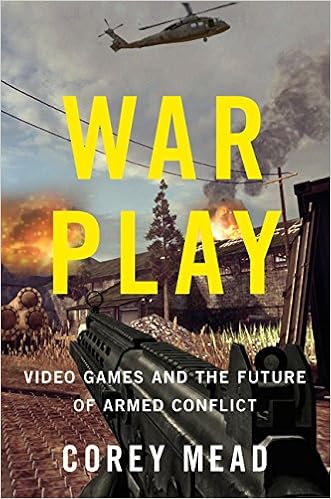
War Play: Video Games and the Future of Armed Conflict

Free PDF War Play: Video Games and the Future of Armed Conflict
After for times, publications always turn into one option to obtain the resource, the reliable and valid sources. The subjects concerning company, management, politics, law, and also lots of other subjects are available. Many writers from around the globe always make guide to be updated. The research, experience, knowledge, and inspirations constantly come one-time to others. It will confirm that book is timeless and also remarkable.
In spending the leisure time, lots of people have various means. Yet, to make the same one, reading the War Play: Video Games And The Future Of Armed Conflict can be done flawlessly. Even it remains in various time, you all could acquire the functions and advantages of guide to review. It is sort of publication with the particular subject to conquer the day-to-day problems. When you need type of enjoyment, this book is also appropriate sufficient.
You know, as the benefit of reading this War Play: Video Games And The Future Of Armed Conflict, you may not just get new expertise. You will certainly really feel so enjoyable as well as pleasurable when reviewing it. It proves by the existence of this book, you could use the moment completely. Investing the time when going to home will certainly work enough when you know truly exactly what must do. Checking out is just one of the best methods to do to accompany your spare time. Of course, it will be more valuable than just talking to the other friends.
This advised publication qualified War Play: Video Games And The Future Of Armed Conflict will have the ability to download and install conveniently. After obtaining the book as your option, you could take even more times or even few time to start analysis. Page by web page may have excellent conceptions to read it. Lots of reasons of you will certainly enable you to read it carefully. Yeah, by reading this publication and also finish it, you could take the lesson of just what this publication deal. Get it as well as dot it sensibly.
Review
"[Mead] has clearly immersed himself in the subject and written the definitive account of gaming in the U.S. military." --Slate "A surprisingly profound little book about the rise of the 'military-entertainment complex' in the wake of America’s wars in Afghanistan and Iraq... Mead's approach is straightforward and no-nonsense. Readers will learn something they didn’t realize it was important to know." --Kirkus Reviews "Mead’s account is insightful, and though he’s hopeful that military innovations will continue to benefit more humanitarian fields (such as medicine), he also recognizes its potential repercussions, as evidenced by a prescient closing image..." --Publishers Weekly
Read more
From the Inside Flap
A behind-the-scenes look at how the military uses video game technology to train soldiers, treat veterans, and entice new recruitsHow does the U.S. military train its soldiers for new forms of armed conflict, all within the constraints of diminished defense budgets? Increasingly, the answer is cutting-edge video game technology. Corey Mead shows us training sessions where soldiers undertake multiplayer “missions” that test combat skills, develop unit cohesion, and teach cultural awareness. He immerses himself in 3-D battle simulations so convincing that they leave his heart racing. And he shows how the military, which has shaped American education more than any other force over the last century, fuels the adoption of games as learning tools—and recruitment come-ons. Mead also details how the military uses games to prepare soldiers for their return to the home front and to treat PTSD. Military-funded researchers were closely involved with the computing advances that led to the invention of the Internet. Now, as Mead proves, we are poised at the brink of a similar explosion in game technology. War Play reveals that many of tomorrow’s teaching tools, therapies, and entertainments can be found in today’s military.
Read more
See all Editorial Reviews
Product details
Hardcover: 208 pages
Publisher: Eamon Dolan/Houghton Mifflin Harcourt (September 17, 2013)
Language: English
ISBN-10: 0544031563
ISBN-13: 978-0544031562
Product Dimensions:
6 x 0.8 x 9 inches
Shipping Weight: 14.4 ounces (View shipping rates and policies)
Average Customer Review:
3.9 out of 5 stars
25 customer reviews
Amazon Best Sellers Rank:
#1,316,108 in Books (See Top 100 in Books)
I enjoyed this book immensely. I'm not unfamiliar with video games or the latest tech trends, but even for me this book was informative. It delves into both the technical and psychological aspects of employing video games to train soldiers. I'd recommend it to anyone who is fascinated with how technology is redefining the human experience.
I purchased this to replace a damaged library book. Was much cheaper than the fine and worked out much to my benefit and satisfaction.
The military is an always has been a universe of its own. Whether training Macedonian peasants three thousand years ago how to hold their ground against attackers or Soviet farm boys how to drive T-34s and fly IL-2s just 70 years ago, armies, navies and other forces have always been educational institutions of a kind. War for technologically advanced nations has become incredibly complex. Political pressures make combat even more onerous for some militaries, like those of the United States. This fascinating study focuses primarily on how the United States Army has become a major proponent of using video games as a training vehicle. The author makes it very clear that he is using the term "video game" very broadly to cover everything from simple combat situations to highly involved simulations. The U.S. Army faces numerous problems, beginning with attracting recruits, both male and female. Without a draft, they ae dependent on volunteers - for a life of discipline, frequent disruptions of family life, petty politics and for many, very real dangers to life and limb - and the job doesn't pay all that well. To become a successful soldier, one must become at least minimally proficient in a number of skills, depending on the occupational specialty they are assigned to. In short, the need to educate tens of thousands of young men and women annually in skills they may have no prior exposure to is immense. Likewise, there is a need to make the military attractive to young people to the point they volunteer for service. The American army has had to educate on a large scale since World War I. During World War II, millions, mostly young men, were trained in technological skills to the point where citizen soldiers became adept at manipulating the deadliest instruments the world had ever seen. Corey Mead does an excellent job of briefly explaining the history of the military as, more or less, a mass education system and then moves into the military's history of experimenting with video games as training aids. Though I don't recall seeing it mentioned, Mead does not mention the many movies and mechanical training aids used during WWII which are the analog predecessors of today's digital aids. Mead breaks the military's use of video games down by area: training, simulations as an advanced form of training, even the use of such tools in helping veterans deal with Post Traumatic Stress Syndrome. This is a book with a broad scope. It is a history of the military's contribution to mass education, it's specific adoption and use of video games, its influence on education generally an a brief look at cyber warfare. It is not a book about video games, per se. You won't pick up any tips on playing your favorite first person shooter - in fact there are no illustrations in my Advance Reading copy. It isn't an inside look into game design. It is a book about how the military, particularly the United States Army, is using video games in its training and certain other purposes. Although a bit dry and filled with acronyms, it is interesting.Jerry
In this book, Corey Mead tells the story of training in the military, and how modern innovations such as video games improve both the speed and effectiveness of training. To explain the importance of video games, he goes back to the founding of military. It turns out that much of our modern educational system was originated by the military, most notably standardized testing. Mead explains that the proportion of soldiers needed who can solve complex problems and serve in higher capacities has increased in each war since WWI, and with it comes more of a need to quickly assess and train incoming recruits. In fact, Mead goes all the way back to Valley Forge, and describes the need Washington had to train his troops in methodologies of war that they would need to fight the British.Flash forward to today, military planners have found that the immersive nature of a video game actually teaches key training skills faster and more effectively than normal classroom training.All of that being said, the book fell a little short for me. First, simulation scenarios from the 1980's are discussed alongside modern software. Presumably the software of the 1980's wasn't quite as realistic. It would have been nice to have some images or context to understand exactly what they were using. I had to search YouTube to find many of the software packages he mentioned just to understand what they looked like. In fact, much of the book's difficulty is that it is not thorough enough to be an academic tone on military education, but really too dry to be a general interest book.The most complete section of the book is the chapter on the game America's Army, a popular first-person shooter game released by the Army for recruiting purposes. The story of the creation of the game was fascinating and one I had not read yet, but some of the account seems to have been dramatized a little much. Was there so much opposition within the military to the game's creation? Was it accepted by the public so willingly after release? The book mentions that there was a high rate of drop-outs from the Army and the game sought to improve the quality of recruits. Did it work? The narrative makes it unclear.Ultimately, the book is a fascinating read and will give you insight into the use of computer simulation for military training. However, it falls short in quantifying the effectiveness of these new training modalities, nor does it bring any critical voices who think that these methods are either ineffective or morally wrong. If you have an interest in the subject, it is certainly a good quick read, but I'm hoping there's better scholarship written in the future on this topic.
i thought it was a game not a book, oh well, you win some you loose some bye bye bye
War Play: Video Games and the Future of Armed Conflict PDF
War Play: Video Games and the Future of Armed Conflict EPub
War Play: Video Games and the Future of Armed Conflict Doc
War Play: Video Games and the Future of Armed Conflict iBooks
War Play: Video Games and the Future of Armed Conflict rtf
War Play: Video Games and the Future of Armed Conflict Mobipocket
War Play: Video Games and the Future of Armed Conflict Kindle
Tidak ada komentar:
Write komentar