
Get Free Ebook The Hidden Brain: How Our Unconscious Minds Elect Presidents, Control Markets, Wage Wars, and Save Our Lives, by Shankar Vedantam
New upgraded! The current publication from a very popular author finally appears. Schedule, as a remarkable reference becomes what you should obtain. What's for is this book? Are you still thinking of what guide is? Well, this is exactly what you probably will get. You should have made appropriate selections for your far better life. Reserve, as a source that might include the truths, opinion, literary works, religious beliefs, and many others are the great friends to accompany.
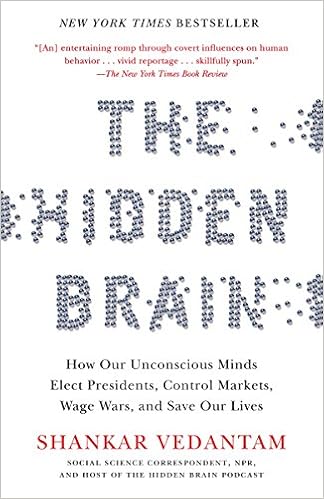
The Hidden Brain: How Our Unconscious Minds Elect Presidents, Control Markets, Wage Wars, and Save Our Lives, by Shankar Vedantam

Get Free Ebook The Hidden Brain: How Our Unconscious Minds Elect Presidents, Control Markets, Wage Wars, and Save Our Lives, by Shankar Vedantam
Come follow us each day to recognize what books updated each day. You know, guides that we offer daily will be updated. And currently, we will certainly offer you the new book that can be recommendation. You can select The Hidden Brain: How Our Unconscious Minds Elect Presidents, Control Markets, Wage Wars, And Save Our Lives, By Shankar Vedantam as the book to review now. Why should be this publication? This is one of the most up to date book collections to upgrade in this site. Guide is additionally recommended due to the solid factors that make numerous people like to utilize as reading product.
When coming with The Hidden Brain: How Our Unconscious Minds Elect Presidents, Control Markets, Wage Wars, And Save Our Lives, By Shankar Vedantam, we feel really certain that this book can be a good product to review. Reviewing will certainly be so enjoyable when you like the book. The subject and also exactly how guide is presented will certainly affect exactly how someone likes reading more and a lot more. This publication has that part to make many people fall in love. Even you have couple of mins to spend every day to read, you could really take it as benefits.
The presented book The Hidden Brain: How Our Unconscious Minds Elect Presidents, Control Markets, Wage Wars, And Save Our Lives, By Shankar Vedantam we offer right here is not sort of normal book. You know, reviewing now doesn't mean to handle the printed book The Hidden Brain: How Our Unconscious Minds Elect Presidents, Control Markets, Wage Wars, And Save Our Lives, By Shankar Vedantam in your hand. You could get the soft file of The Hidden Brain: How Our Unconscious Minds Elect Presidents, Control Markets, Wage Wars, And Save Our Lives, By Shankar Vedantam in your gadget. Well, we mean that the book that we proffer is the soft data of guide The Hidden Brain: How Our Unconscious Minds Elect Presidents, Control Markets, Wage Wars, And Save Our Lives, By Shankar Vedantam The material and all points are same. The difference is only the forms of the book The Hidden Brain: How Our Unconscious Minds Elect Presidents, Control Markets, Wage Wars, And Save Our Lives, By Shankar Vedantam, whereas, this problem will exactly be profitable.
Yeah, checking out a book The Hidden Brain: How Our Unconscious Minds Elect Presidents, Control Markets, Wage Wars, And Save Our Lives, By Shankar Vedantam could add your pals checklists. This is just one of the formulas for you to be effective. As known, success does not indicate that you have excellent points. Recognizing and also understanding even more than various other will offer each success. Next to, the message and also perception of this The Hidden Brain: How Our Unconscious Minds Elect Presidents, Control Markets, Wage Wars, And Save Our Lives, By Shankar Vedantam could be taken and chosen to act.
Review
"In The Hidden Brain, one of America's best science journalists describes how our unconscious minds influence everything from criminal trials to charitable giving, from suicide bombers to presidential elections. The Hidden Brain is a smart and engaging exploration of the science behind the headlines—and of the little man behind the screen. Don't miss it."—Daniel Gilbert, author of Stumbling on Happiness"Shankar Vedantam brings his critical eye to a question that has haunted scientists and writers for centuries: Does the unconscious matter, and if so, how? With a light touch, the book takes us through the complicated landscape of research on psychology and human behavior. We come away not only understanding how we act, but Vedantam moves past mainstream economic reasoning to shed light on the relationships we create with each other. The book addresses the madness and beauty of our struggles to create a moral and just world." —Sudhir Venkatesh, author of Gang Leader for a Day: A Rogue Sociologist Takes to the Streets
Read more
About the Author
Shankar Vedantam is a national correspondent and columnist for the Washington Post and a 2009 Neimann Fellow. He lives in Washington, DC.
Read more
See all Editorial Reviews
Product details
Paperback: 288 pages
Publisher: Spiegel & Grau; 1 edition (August 31, 2010)
Language: English
ISBN-10: 0385525222
ISBN-13: 978-0385525220
Product Dimensions:
5.2 x 0.6 x 8 inches
Shipping Weight: 7.8 ounces (View shipping rates and policies)
Average Customer Review:
4.2 out of 5 stars
148 customer reviews
Amazon Best Sellers Rank:
#224,665 in Books (See Top 100 in Books)
If you read a lot of books in this genre, then this is likely to be a retread of older studies for you. If not, then you might enjoy it. It's an easy read, and there's a lot of fascinating material.That said, the author's own "hidden" biases are on full display as well. His chapter on racist bias immediately and definitively sets about showing that racism exists - the author relaying his own personal experiences with it as a minority - and then explores why. In fact, he has a couple of chapters that deal with racism in a fairly masterful way. Those are worth a read. However, in the chapter on sexism, he spends a few pages rambling on about how there's no real way to establish in any useful form that sexism is behind any individual incident that involves a woman. He eventually did get it together and pull out of his spiral to discuss sexism as experienced by trans individuals, but not without the disclaimer that a lot of that discrimination might be attributable to bias against alternative sexuality. Having read substantial amounts of - yes, scientific - as well as less rigorous studies into sexism, I found that chapter sloppy and poorly assembled. It was clearly not the priority for him that racism was. And being dismissive of 51% of the global population is probably a poor strategy for success. I'd have more respect for his book if he simply said, "I'm going to focus on racism since it's where my interest lies," and then not addressed sexism at all. Fair enough - we tend to speak to what we know. But to throw in a sloppy, poorly assembled chapter on sexism, and then act as if it could barely be quantified as a societal force - despite the massive crowds of people globally saying otherwise - felt insulting and dismissive. Definitely a turn-off.All in all, I can't give this a huge thumbs up or down. It's okay. But if you're only going to read one book in this genre, I'd recommend "Mistakes were Made But Not By Me" or "Dataclysm."
This was a very enjoyable read, as most people are not consciously rascist or sexist, but they do have hidden biases of which they are not even aware. I just wish there was more than one chapter about sex bias; the author does first-person interviews with a man-to-woman transgender, and also a woman-to-man transgender working at the same place in the same scientific field, and compares their experiences before and after the gender change. That's one of the most compelling and credible things I've ever read about sex bias in the workplace, and I do wish he included more examples or expanded to more chapters.Unfortunately, this book was also repetitive about race bias. There are several chapters about that, but it does seem that the author only tested for bias on Americans and only on black or white people. He didn't test for bias against any other races or by any other races. That makes this book somewhat incomplete.Also, I have my own bias: I think that Americans make everything about race, especially after Obama. In the current news, Meghan Markle just got engaged to Prince Harry, and the big deal in the tabloids is that she's half African-American. So, does race matter or does it not? If it's not supposed to be important, then why is it being reported at all? Maybe that's why racial bias is so prevalent here--it's not important, except when it is, and then it's a big deal.
Unlike our normal (conscious) brain, which is live and tangible, the unconscious brain, referred to in this book as the "hidden brain", is intangible and elusive. In fact its own existence was in question. Ever since it was given its name (by Friedrich Schiller in 18th century) it was questioned or even rejected by some psychologists. However, its function and influence were evident enough to engage the attention of famous psychologists like Sigmund Freud and Carl Jung who developed the concept and employed it in psychoanalysis and other psychological problems. In fact, Freud made the concept popular and it became one of his main contributions to psychology.Freud likened the mind to an iceberg with its tip (above the water ) being the conscious mind and the bulk of it (under the water), being the unconscious mind. This is significant as it implies that most of mental work is done by the unconscious mind. Later research and development showed this to be true. Indeed some psychologists believe that only 25 percent of our mind's work is accomplished by our conscious mind. What is curious about this arrangement is that the conscious mind is mostly unaware of the actions of the unconscious mind. This is not only surprising but also mystifying. In other words , after having made a seemingly conscious decision we would be told it was really the hidden brain that had done the work,or at least had guided us to the decision. If someone is told that he does not understand how his mind works he is likely to be offended, yet, this has become an acceptable fact in psychology.The contents of this unconscious mind have been somewhat of a mystery. Freud thought it is a reservoir containing our feelings, concerns, fears, and memories which are outside the scope of our awareness. The reason they are suppressed down below is because their surfacing might be disturbing or annoying, e.g. like remembering an ugly crime . How can one access this reservoir? One way is through psychoanalysis as Freud had done using the power of reasoning and allowing several sessions to unravel a patient's background. More often the contents surface in dreams or else through hypnosis. On reading about this strange arrangement one cannot help but wonder: Was this an integral part of our creation, or did it evolve in us over time?Although we are accustomed to think of the unconscious mind at the personal level, the author gives it another dimension by demonstrating its effect in groups and institutions. He does this using anecdotes and case studies. The danger here is that often the anecdote is in itself so exciting that it overshadows the psychological analysis. One issue dealt with here is racial bias which is presumably generated by our unconscious brain. One researcher in Canada, G. Aboud, tried to trace the origin of this issue by showing little children a picture of a white man and a black man. She would tell the little 3-5 years-old stories about a robbery, or any other offending event, and ask the children to point to the possible culprit in the picture. Invariably most of them would point to the black man . No matter how the question was repeated the result was the same. Where did this bias come from? Parents? Teachers? Friends? She wondered. And would it be embedded and sealed in their hidden reservoir until it surfaces later in life creating our modern-day problematic racial discrimination?Surely, there is a lot more research to be done on this mystifying unconscious mind.Fuad R. QubeinAugust,2016
This was a great book that I couldn’t put down. Shankar is a great storyteller, which personalizes and creates a visceral response to scientific/psychological subject matter that most would rather pass on. He tackles tough subjects to bring light to areas of our life where we may be making unconscious choices and then logically validating them?Want to know how Obama could overcome racism, why we’re terrible witnesses, or why we just don’t like some people? Give this a try
The Hidden Brain: How Our Unconscious Minds Elect Presidents, Control Markets, Wage Wars, and Save Our Lives, by Shankar Vedantam PDF
The Hidden Brain: How Our Unconscious Minds Elect Presidents, Control Markets, Wage Wars, and Save Our Lives, by Shankar Vedantam EPub
The Hidden Brain: How Our Unconscious Minds Elect Presidents, Control Markets, Wage Wars, and Save Our Lives, by Shankar Vedantam Doc
The Hidden Brain: How Our Unconscious Minds Elect Presidents, Control Markets, Wage Wars, and Save Our Lives, by Shankar Vedantam iBooks
The Hidden Brain: How Our Unconscious Minds Elect Presidents, Control Markets, Wage Wars, and Save Our Lives, by Shankar Vedantam rtf
The Hidden Brain: How Our Unconscious Minds Elect Presidents, Control Markets, Wage Wars, and Save Our Lives, by Shankar Vedantam Mobipocket
The Hidden Brain: How Our Unconscious Minds Elect Presidents, Control Markets, Wage Wars, and Save Our Lives, by Shankar Vedantam Kindle
Tidak ada komentar:
Write komentar